Acrylic solid surface
A cast composite of PMMA acrylic resin and aluminium trihydrate (ATH). Homogeneous through its full thickness, non-porous, repairable. The base material for worktops, sink areas, façades, reception desks and healthcare furniture.
What the sheet
is made of
Four groups of components. None of them contains styrene — this is what separates acrylic solid surface from modified polyester stone, which looks much the same from the outside.
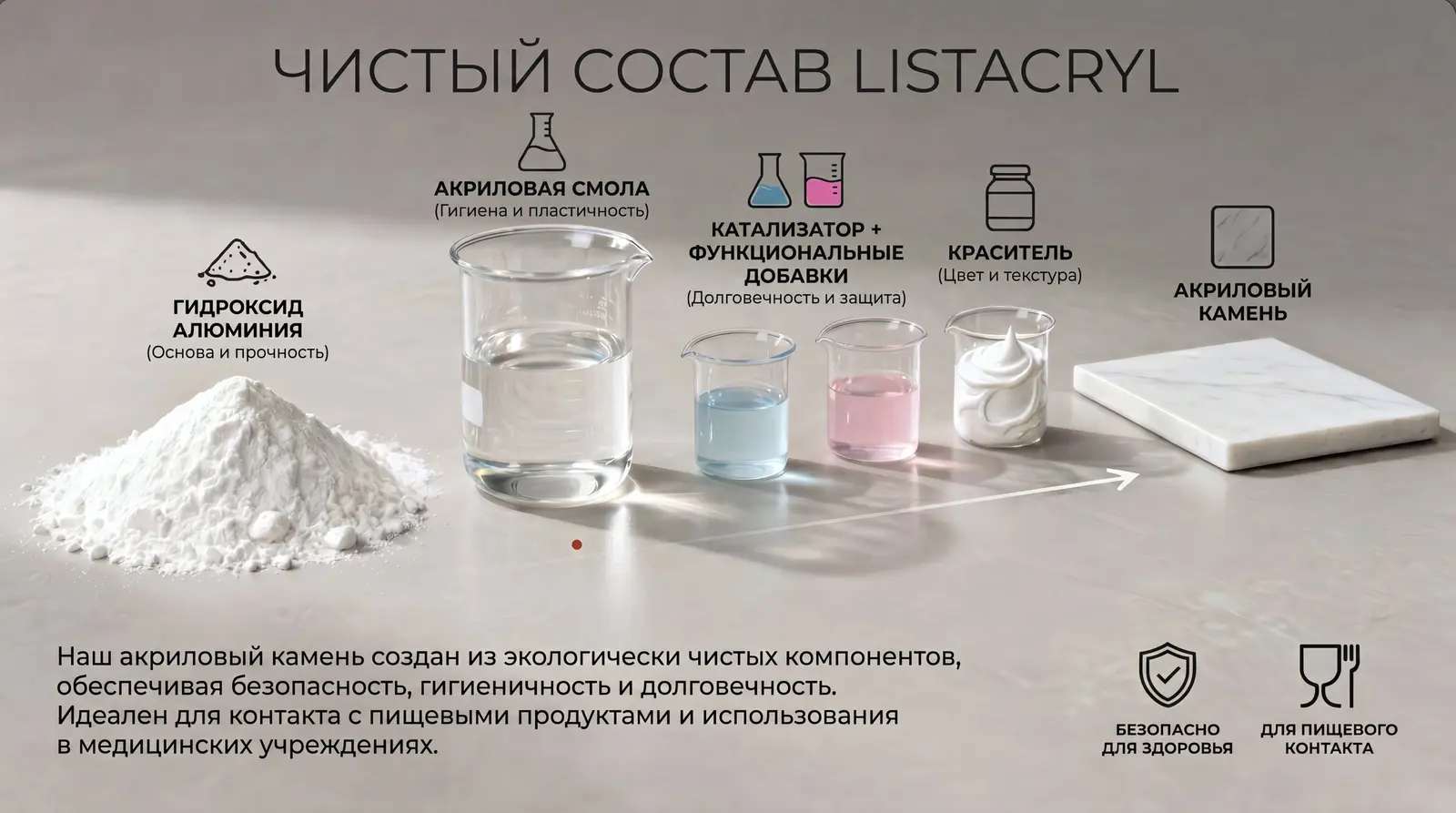
- Acrylic resin (PMMA)
- The binder. Responsible for translucency of the mass, UV stability and repairability.
- Aluminium trihydrate (ATH)
- Mineral filler derived from bauxite. Gives hardness, suppresses combustion and prevents fading.
- Catalyst and cross-linkers
- Drive polymerisation and set the final polymer network.
- Pigments and decorative chips
- Colour to the RAL palette and the pattern of the mass, from solid tones to coarse-particle decors.
Technical data
for the sheet
Values from test report No. 003/A-18/08/26 dated 18 August 2026 (Lira-Test laboratory) and test report No. PB26-17-08/1 dated 17 August 2026 (POZHTEKHSERT laboratory).
| Density | 1.78 g/cm³ (111 lb/ft³) |
|---|---|
| Mohs hardness | 4 |
| Water absorption | 0.2 % by mass |
| Flexural strength | 58 MPa (8,412 psi) |
| Flammability group | G2 (at 12 mm) |
| Ignitability group | V2 |
| Smoke generation | D2 |
| Combustion product toxicity | T2 |
Fire classes follow Russian standards GOST 30244-94, GOST 30402-96 and GOST 12.1.044-2018.
| Sheet length | 3660 mm (144.1 in) |
|---|---|
| Sheet width | 760 mm (29.9 in) |
| Thickness | 12 · 16 · 19 mm (0.47 · 0.63 · 0.75 in) |
| Binder | PMMA acrylic resin, styrene-free |
| Filler | Aluminium trihydrate (ATH) |
| Colour | RAL palette, made to order |
| Repairability | Full, by local sanding |
| Price | On request, depends on volume and colour |
760 mm is the current width of the line. Widening to 1520 mm is planned; confirm available formats with the sales team.
Acrylic versus polyester
A large share of what is sold as cast stone in Russia is poured on modified polyester resin with styrene. It looks similar and behaves differently.
| Parameter | LISTACRYL · PMMA + ATH | Polyester stone with styrene |
|---|---|---|
| Binder | Acrylic resin, no styrene | Polyester resin with styrene |
| UV stability | Does not yellow | Yellows over time |
| Thermoforming | Deep draws, stable geometry | Limited, risk of crazing |
| Joints | Monolithic, visually invisible | Become visible over time |
| Surface repair | Full restoration by sanding | Leaves visible boundaries |
| Impact behaviour | Higher, more forgiving matrix | Lower, chips and micro-cracks |
What you can do
with the sheet
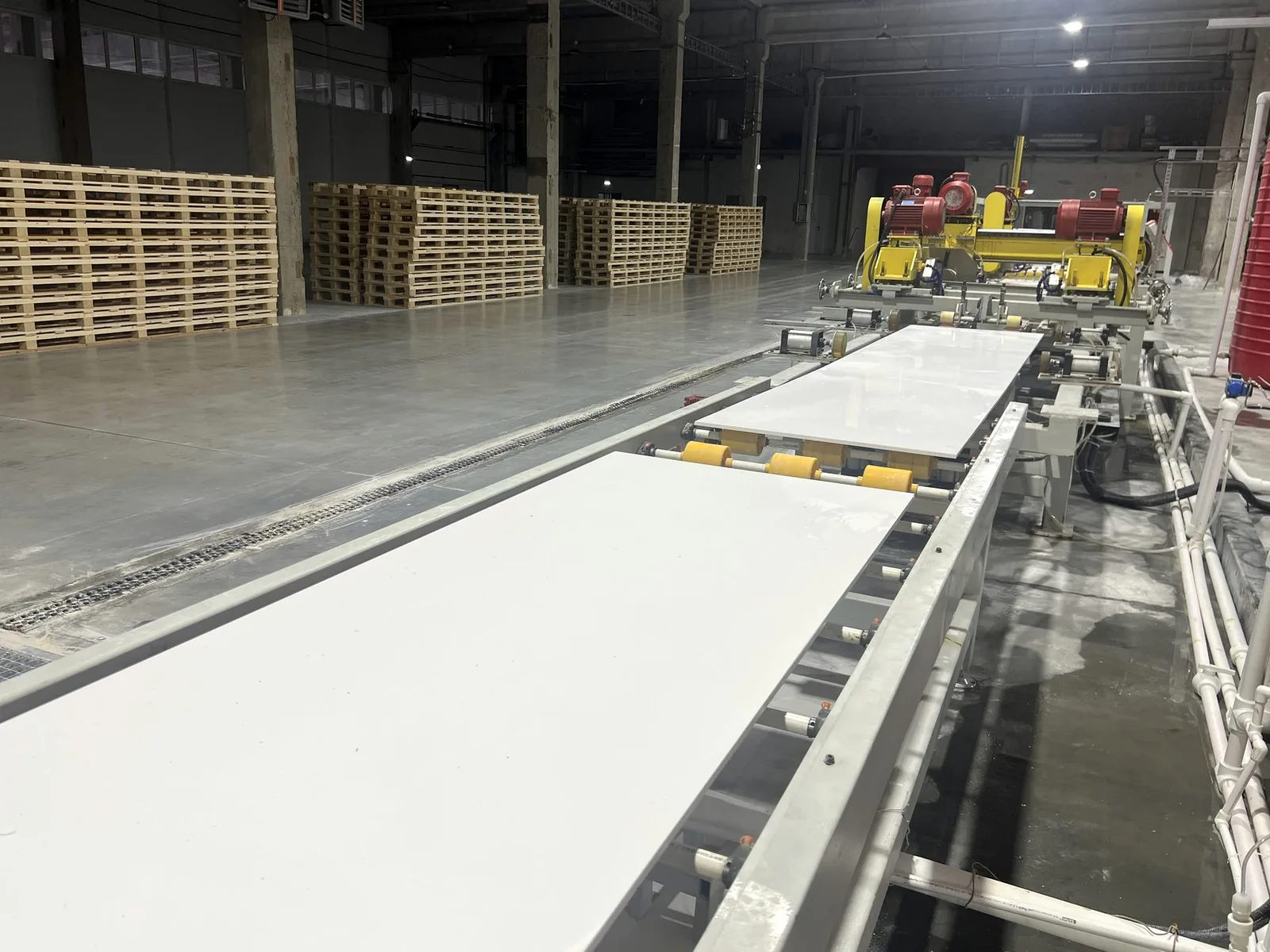
The material is worked with standard woodworking and routing tools. Below is the usual route from sheet to finished piece.
Cutting
Panel saw or CNC router with carbide tooling. Keep inside corners radiused, R10 minimum, so the part does not collect stress.
Routing and edging
Edge profiles, cut-outs for sinks and hobs, 3D engraving. Feed rate follows the thickness.
Bonding
Two-component acrylic adhesive matched to the sheet colour. The joint is sanded flush and becomes visually indistinguishable — this is what a seamless surface means.
Thermoforming
Heat until the mass softens, then form in a mould. The acrylic matrix takes deep draws without whitening or crazing.
Sanding and finish
Matte, satin or polished — it is a question of the final abrasive grit. Years later the same method restores the surface.
Installation
Mount on a prepared substrate with room for thermal movement, bond the seams. Local damage is repaired in place.

Some things
you have to hold
We ship a sample set: colour, finish texture, thickness and the weight in your hand. The current price list and technical documentation come with it.
Where solid surface
came from
The material is more than half a century old. The Russian line continues that history rather than copying it.
Prototype and the DuPont patent
A research team in Buffalo mixed the first sample of a hard surface in an old Hobart household dough mixer. DuPont patented the material in 1967; the market knows it as Corian.
Switching to aluminium trihydrate
Replacing calcium carbonate with bauxite-derived ATH removed fading, added acid resistance and opened up the colour palette.
The market opens
The patent expired and the industry grew to roughly twenty major producers: Hanex, LG Hi-Macs, Krion, Staron and others.
The Russian line
LISTACRYL is a full-cycle plant in Kirishi: in-house formulations, a laboratory on site, palettes built for local interiors, and ADC as our own development.
Request samples
and supply terms
We send sheet samples, the current price list and technical documentation. Expect a reply within one business day.